Showing posts with label tutorial. Show all posts

Sunday, 5 June 2016

Circlepuff Square Crochet Pattern

Circlepuff Square crochet pattern - US terms

Round 1: make 16 tr in magic ring.
Round 2: join next colour between 2 tr. Ch 2, make puff stitch in same sp (*yarn over, insert hook* 4 times - 5 loops on hook. Yarn over and pull yarn through all 5 loops - puff stitch made.) Ch 2, puff stitch between next 2 tr. Continue around - 16 puff stitches.
Round 3: join next colour in a ch 2 space. Ch 2 and make 16 puff stitches as in round 2 - but yarn over 5 times for each stitch, and ch 3 between puffs.
Round 4: join next colour in a ch 2 space. Ch 4, 2 tr in same sp. 3 dc in next sp. 3 hdc in next sp. 3 dc in next sp. 3 tr, ch  2, 3 tr n next sp (corner made). Continue around, finishing with 3 tr, ch 2 in same sp you started in.

Tips for puff stitch: pull your hook up a little each time you yarn over to keep the yarn fairly loose, so it is easier to pull through on the last yarn over. Try not to wiggle the hook too much as you pull through so it doesn't catch the loops.
When sewing in the ends, give a good tug on the end from the beginning of the round as this makes the ch2 at the start as small as possible.

Saturday, 26 September 2015

Puff Stitch Pincushion crochet pattern

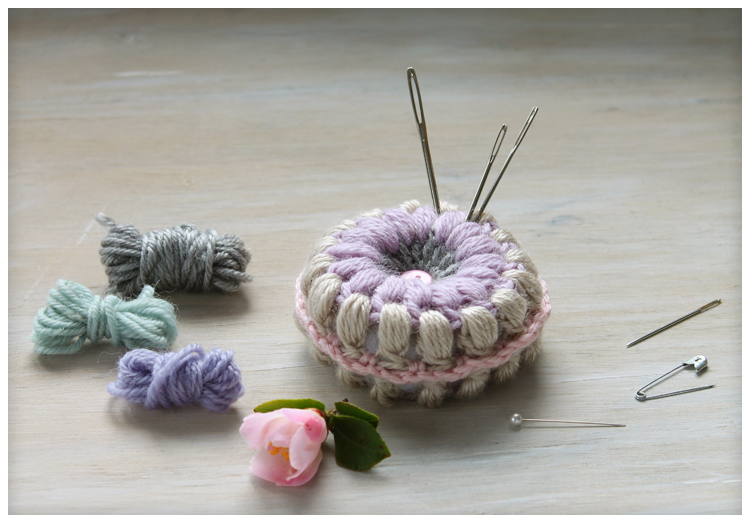
 I've been working on squares for my latest blanket, and having a lot of fun with the process. I've made a lot of circles and soon the time will come to add the last round of stitches and turn them into squares. As happy as that thought makes me, I'll miss having all these circles around, so I decided to turn a couple of them into a pincushion. I really needed one to store all my yarn needles as I am forever losing them down the couch, so it was the perfect opportunity to fulfil several needs!

 The spaces between the puffs are great for jamming a thick needle in! You can also attach safety pins or stitch markers around each puff.

You could use this as a scissor keep, although I find those a bit bulky, so I just made a loop for it so I can pin it to the side of the couch when I need to keep it handy.

Puff Stitch Pincushion crochet pattern

Working a puff stitch: yo, insert hook into space and pull yarn through (3 loops on the hook), repeat 3 times (9 loops on the hook). Keep your tension quite loose as you are doing this - the loops should not be wrapped tightly around the hook. Yo again, then carefully draw the hook through 8 loops (2 loops on hook). Yo and draw the hook through the last 2 loops.

Round 1: Ch 4, make 15 treble crochet stitches into a magic ring.
Round 2: Ch 2, make 16 puff stitches, working into the space between each tr, with 1 ch between each puff.
Round 3: Repeat Round 2. Fasten off.

Make two circles, then hold them wrong sides together. Work all stitches into both circles to join them. With a contrasting yarn, attach with a slip stitch into one of the ch 1 spaces. Ch 1, 1 sc into same space, ch2, 1 sc into space between puffs, repeat until 3/4 of the circles are joined. Stuff the pincushion, then finish joining. Before fastening off, ch 20 to make a loop for hanging. Join the end of the loop and fasten off.

Take 2 small buttons and sew them one on each side of the pincushion, drawing the thread tight between the buttons. Fasten off thread.

Monday, 7 September 2015

Adding a crochet hem to a dress, and Wavy Pocket crochet pattern

 I bought this dress a while ago because I thought it was cute with its polka dotted heart print. The dress was a good fit but was just a bit too short for me to be comfortable with. No problem, I thought, I'll just crochet a trim on the bottom, easy, and that will make it wearable! It was easy too, but as I am such a great procrastinator it sat in my wardrobe for at least a year (yes, truly) before I got round to doing it.

 Here it is at last! I started with a blanket stitch along the edge of the dress, then did a round in dc. I did 3 dc to each loop of the blanket stitch, but it depends on your stitch size - 2 dc might fit better. I used the edging for the All Shawl by Doris Chan which works up into this beautiful lacy pattern. I used thin 4 ply cotton yarn and a 3mm hook, and adapted the last row slightly to skip every second scallop and make the others a bit bigger (chain 4, sc into 3 ch space, chain 4, between each scallop).

I also thought that a couple of pockets would finish it off nicely! I created a pattern for these which picks up on the dc increases in the edging pattern. It also gives a a scalloped edge for the pockets.

Ch 19 to start.
Row 1: 1 dc in third ch from hook (as I wanted a slightly rounded corner I worked into the third chain rather than the fourth), 1 dc in next 15 chains, 2 dc in last ch.
Row 2: ch 2, 1 dc in same dc. 1 dc in next 17 dcs. 2 dc in last ch.
Row 3: ch 3, 1 dc in next 2 dc, skip 1 dc, *(2 dc, ch 1, 2 dc) in next dc, skip next dc, 1 dc in next 3 dc*, repeat from * till end of row.
Row 4: ch 3, 1 dc in next 2 dc, *(2 dc, ch 1, 2 dc) in ch 1 space, 1 dc in next 3 dc*, repeat from * till end of row.
Repeat pattern until pocket is desired size.

I have my new dress for spring, now all I need is some warmer weather so I can wear it... hopefully not long to wait now!

Friday, 28 February 2014

Summertime Patchwork Quilt Blanket - finished at last!

 Happy news this week, as I've finished my Summertime Patchwork Quilt Blanket. I started this in September 2011 and it's been a really good evenings-in-front-of-the-TV sort of project. I've worked on other things in between as well, which is why it's taken two and a half years, but I'm happy now to call this project finished. It's the last week of summer so it's just in time... and actually today a wintery cold front has blown in, so I'll need this blanket anyway! (9 degrees in February, what??)

 I used a variety of yarns. It began as a stash buster, but I had to buy a few balls as well to fill out the colour range. They are all around the 4-ply weight and I used a 3.75mm hook. For a couple of yarns which were thicker (like the blue) I used the same sized hook, but did the last round in hdc instead of dc.

I sewed the hexagons together as I worked. My method was to make about 6 or so, then sew in the ends. Then I would lay out the blanket and arrange the new pieces, and safety pin them in place. (This meant I could fold up the blanket out of the way when I wasn't working on it.) When I had a good lot of hexies pinned, I'd have an evening of sewing them in. I used my most neutral coloured thread which I decided was peach, and whipstitched them together through the back loops only. This helped give a bit of textural interest and more of a 'quilted' look.

I always knew I wanted a simple white edging with perhaps some picots. I did dabble on Pinterest for a while looking at fancy lacy borders and whatnot, but in the end I went with my original vision and I think it's perfect. I decided to make half-hexies to fill in the obvious gaps in the ends, but I liked the points on the long edges and they set off the picots nicely.

 I even steam blocked the blanket to get it to drape nicely. It was very easy and made sure that the edges held their shape.

 Here's the whole blanket laid out after I blocked it. It's a good, drapey, 1-2 person blanket, nice and lightweight, perfect for cool summer evenings.

 You can see my project page here on Ravelry.


Basic Hexagon Pattern
(US terminology)

Round 1: make a magic ring. Ch 3 (counts as first dc), dc into ring, ch 1. 2 dc into ring, ch 1, repeat 4 times (12 dc). Slip stitch into first ch 3. (2 dc in each branch of hexagon)
Round 2: Ch 3, dc into next 2 dc, dc into corner ch, ch 1, dc into corner ch, repeat around. (4 dc in each branch of hexagon)
Round 3: Repeat as for Round 2, with 6 dc in each branch of hexagon. If using a thicker yarn, do this round in hdc instead of dc.


Monday, 24 February 2014

How to install a water feature

 Recently it was my mum's birthday, the big six-oh. My brother and I were wondering what to get her, and decided a water feature would be an ideal gift. They are pretty expensive to buy as a kit, so we thought we would DIY one. There are plenty of instructions online if you google 'Pot Fountain', and we also watched this video which was really helpful!

Here's what we did to install our pot fountain water feature.

 You will need:
-A pot. Ours is about 800 mm tall. We bought it from Pottery International who were super helpful, and also had it coated with "ponding" - a waterproof coating to help protect it and prolong its life.
-A length of PVC pipe to go up the inside of the pot, approx 20 mm diameter
-A length of flexible tubing (we used hosepipe)
-A connector to go in the base of the pot and connect the hose and PVC pipes together (shown in the above picture attached to the hosepipe)
-Plumbers' kneadable waterproof putty
-A pump (1500 litres for an 800 mm tall pot)
-A large plastic bin with lid
-Bricks or concrete blocks
-Sand
-Pebbles or decorative stones
-Power drill

Here is a rough diagram I made showing how everything fits together. It's pretty simple, all you have to do is put it together!

 This is the bin we used for our reservoir. It's a 52 litre plastic bin with a lid. (Use the bin to transport a bit of sand for lining your hole!)

 Dig a hole the size and depth of your reservoir. Line it with the sand - this helps to level the bin without having to keep digging.

 Put the reservoir in and make sure it's level. Fill in around the bin with sand and soil.

 Put some bricks and/or concrete blocks in so they line up with the top edge of the bin. You might need to experiment a bit to get the right height. These will support the weight of the pot and stop it toppling into the bin.

The concrete block on the bottom had a bit missing out of one end which was handy for leading out the pump cord - otherwise it would need to come out between the 2 bricks.

 Cut the PVC pipe to fit within your pot, a couple of centimetres below the rim. Here's a close up of the connector fitting we used - we found it in the plumbing section at Bunnings. You jam the pipe into the connector then screw the blue piece onto it. We removed the blue piece from the bottom (where it connects to the hose) but left it on the top piece so there would be something to stop the pipe from slipping through the hole in the pot.

Put the pipe inside the pot, making sure the connector goes through the hole at the bottom. Apply the plumbers' putty in a ring around it and smooth it with your fingers to fill all the gaps. Use more putty if you need to. (It's a good idea to check before you buy a pot if you can reach in with your arm and reach the bottom - otherwise you'll have a lot of trouble with this step.)

 The plumbers' putty dries really fast, so I made a collar out of a piece of cardboard to hold the pipe in place, nice and central. Then go and have a cup of tea.

 After about half an hour the putty inside the pot should have cured. Wedge the hose pipe into the connector on the outside, then cover it with putty. Hooray, it's easier on this side!

 Cut the end off the bin lid above where the pump will go. (This is so you can access the pump without having to dismantle the whole thing later.) Make sure the cut end rests on a brick so it doesn't sag and fall in.

Make a hole in the centre for the hosepipe to pass through. Then make it bigger to fit the lump of putty you just put around it. Drill holes in the lid for water drainage.

 Connect the hosepipe to your pump. Our pump came with three different sized connectors which could screw into the pump, so we chose the one that best fitted the hose. Put the pump in the reservoir - its cord comes nicely out the gap in the lid.

Then, fill the reservoir with water and test the pump. You might need to adjust the flow to make the fountain more or less splashy. 

Once it flows to your liking, cover the reservoir lid with stones. Then sit back and enjoy!

Pumps don't generally come with very long cords, so we had to run an extension cord. It's hidden in the bushes to the right of the fountain. An electrician will probably be required at some stage in the future to put in an outdoor power point, but for now (since it's summer) the cord is tucked up in a waterproof plastic bag when not in use. We made a waterproof case for the connection of the pump plug and the extension cord out of a plastic lidded container with small slots in the sides for the cords to come out. It's hidden away under the ramp so it's protected from the weather.

 Tip: check the water level after you've had the fountain running for a while. We were surprised at how much water it went through after running all day. You might want to get into the habit of topping it up with a watering can after each use. It would also pay to check the water level if it's been several weeks since you've last used the fountain.

I'm looking forward to installing my own water feature one of these days!

Tuesday, 9 July 2013

Vintage-look birdhouse wall decoration

 Earlier this year I decided to make a birdhouse. Ever since I got my garden I've wanted to put a grouping of  rustic, wooden, handmade birdhouses somewhere together. I had some wooden planks lying around to use, and I figured it couldn't be that difficult to cut them to shape and hammer them together. (I'm a fan of the rustic look - imperfections are my friends!) I cut (with my hand saw) a couple of house shaped pieces, and they sat around the garden for a month or so while I debated whether to cut walls out of the same plank or look for some thinner wood. It was very thick you see, and would have made for a rather chunky birdhouse. I was also a bit wary of the drill attachment that makes the big holes; it would require a trip to Bunnings and some enquiring and figuring out on my part and I hadn't quite gotten round to it yet, not to mention what was I going to use for the roof? So all these things were percolating until it occurred to me... it doesn't need to be an actual house... I could just paint it to look like one! And once that decision was made the entire process became easy peasy. (Note: I didn't make the taller birdhouse, this tutorial is just for the smaller painted one.)

Here's how I did it...

 Supplies: wooden plank cut to a house shape (mine measured approx 20 x 11 cm), a small decorative picture frame for the roof, a chopstick, strong wood glue, paint in a light colour and a dark colour, sandpaper, varnish.

 I used the same technique as for my Vintage-look Garden Sign to distress the wooden house shape. Once that was done I painted a circle for the birdhouse hole. I then cut a chopstick to approx 2.5 cm long, drilled a short hole in the front of the house for the perch, and glued the chopstick in place.

A fancy picture frame makes a great faux roof! Mine was the right size so all I had to do was snap it in half diagonally, and carefully file and sand the sharp edges. Then I glued the pointed house roof within the frame. (Spray paint the frame before you glue it on if you want to change the colour.)

If you're going to keep your birdhouse plaque outside, give it several coats of a good outdoor varnish. Attach a wire or picture hook at the back for hanging, or just prop it up behind some pots!

Have fun creating your own birdhouse groupings, I'd love to see pictures if you make one!

Linking up to Matariki Crafting at Tartan Kiwi.

Sunday, 31 March 2013

Easter egg decoration tutorial

I don't usually decorate for easter, but I kept seeing pictures of easter egg trees around the internet. They are pretty cute, and really, why turn down an opportunity to make a little tree and hang decorations from it? Read on to find out how I made these cute little egg decorations.

I used Liquid Pearls to paint tiny flower designs on the eggs. These eggs happen to be plastic, but you could go old school and blow the yolks out of some real eggs too.

Liquid Pearls are a really handy craft product to have lying around! I've used them on all sorts of things from cards to candles. They are a dimensional pearly paint, which you squeeze on in a little blob and it stays raised up when dry. (Here is a good place to buy Liquid Pearls.) You will also need some plastic craft eggs, wooden skewers, thin satin ribbon, and glue.

You can use as many or as few colours as you like. My eggs were different colours, so I used several different paint colours as well. If your eggs are all white, it could look nice to just use two or three paint colours for the flowers. The colours I used were Buttercup, Baby Blue, Lavender Lace, Mint, and Petal Pink.

The plastic egg will have a little hole in one end. Wedge the wooden skewer in the hole so you have something to hold onto while you are painting the egg. (If the hole is bigger than the skewer wrap a bit of blu-tack around to secure it.)

Use the Buttercup Liquid Pearls to make dots for the centres of the flowers. Make sure they are well spaced out to allow room for petals.

Use a second colour (here I'm using Lavender Lace) to make the petals. To do this, squeeze out a dot of paint, then move the nozzle in towards the centre to extend the dot in a petal shape. Do five or six petals for each flower. Then put the end of the skewer in some blu-tack or a piece of foam or polystyrene until the paint dries.

Cut a piece of narrow satin ribbon for the hanging loop. Cut the ends of the ribbon on a sharp diagonal, then use the wooden skewer to push them into the hole in the end of the egg. Then secure with a drop or two of glue.

Make an easter egg tree by securing a couple of twiggy branches in a vase (use a flower frog to hold the branches so they don't flop around). Then decorate with your eggs. I think eggs in different sizes would look cute, and crochet flowers never go astray. This might be the first time I decorated for easter, but it won't be the last! Do you decorate? Have you ever done an easter egg tree?

Thursday, 20 September 2012

Vintage-look garden sign tutorial

Recently on Pinterest I came across a link to this laundry makeover. I really liked the rustic sign they had made, and I thought a similar one would look good in my potager. It was easy and cheap to make, and best of all looks like it has been there for years! Read on for a tutorial.

 You will need a piece of wood for your sign. I used a piece that the builders pulled out of our house when they were taking the chimney down, but pallet wood would also be excellent. Give it a rough sand to remove any splinters, but leave it quite textured.

 You need two colours of paint - black and white (or thereabouts). I used test pots which were super cheap, the dark one is more of a green black but that is fine for these purposes. Put the wood on a work surface, with a couple of small plastic pots or jar lids to hold it off the surface. Paint it with your black paint. Do two coats and let each coat dry thoroughly.

 Take a candle and rub wax all over the sign. It will stick to the raised wood grain. (If you don't have a candle, omit this step. It's not essential but will make distressing the sign a bit easier.)

 Paint ONE coat of white paint on the sign.

 Using a word processing programme, print out the lettering to go on your sign. You can print it in outline to save on ink. Cut around the letters and arrange them on your sign. When you are happy with the arrangement, trace around the letters with pencil.

 Use your black paint and paint in the letters. Do two coats for these. Let the paint dry for at least 24 hours, then take to it with sandpaper!

Lightly sand along the edges to remove the top layer of paint. Be very gentle if you go near the painted  letters as it's easy to remove that layer as well. You can go a bit heavier near the ends, the more distressed the better here! When you have aged the sign to your liking, coat it with some clear varnish if desired, or leave au naturel so the weather can continue your work.

 I decided to hang my sign on the arch leading into my potager garden. I attached it firmly with wire so it doesn't get blown down in a breeze.

And that's it. A house name sign would be really nice, or a coffee sign for your kitchen. The possibilities are endless and all it takes is scrap wood and paint. Happy signwriting!

LinkWithin

Related Posts Plugin for WordPress, Blogger...